

Michele Oliosi
-
Posts
796 -
Joined
-
Last visited
Everything posted by Michele Oliosi
-

Diferencia Producciones entre Informe y Excel Bachsimulation.
Michele Oliosi replied to AlvaroRuiz's topic in Simulations
Ok, so the difference occurs before the evaluation of EArray. My following hypothesis about what is happening is: The electrical shading factor table is changing from one simulation to the other. You can check whether this is the cause for the difference by switching to “linear shadings” and see if the difference persists. The fact that the table changes can be due to 2 different reasons: Since you are changing the pitch, the 3D scene is changed. This means that the shading factor table is recalculated. You should check that the backtracking works as intended. If you have perfectly flat ground, there should not be any electrical shadings, so you can output the variable ShdElec and check whether it is zero. The shading factor table of your variant has been calculated in a previous PVsyst version. In this case, the batch mode will make sure it is recalculated with the latest version. You can make sure this doesn't happen by viewing the Table in Near Shadings and clicking on “Recompute”. -
Can we add the mptor gap and piles gap in trackers ?
Michele Oliosi replied to Nihal Meena's topic in Problems / Bugs
Hi ! Currently, only the torque tube gap can be included in the tracker design. If the motor / pile gap is significant, I would suggest splitting the tracker into several trackers, with the size between the gaps as their individual size. -
Diferencia Producciones entre Informe y Excel Bachsimulation.
Michele Oliosi replied to AlvaroRuiz's topic in Simulations
Ok, we will need to dig deeper. How about other quantities, such as EArray? In the report you find the yearly value in the table. You can also output this variable from the batch. -
I see. This is normal then, because the edited GHI and DHI were chosen in order to give back GlobInc close to GlPMeas when transposed. If you change them, you will not get back the same value. When comparing transposed measured GHI and DHI to GlPMeas, you are accounting for: fundamental uncertainty in the measurement (calibration, noise, ...) uncertainty in the measurement system installation (orientation, position...) Hay model uncertainty Because of this I cannot tell you what is the single source of the 4.9% discrepancy. One thing that is on our roadmap is use one of either measured GHI or DHI in addition to GlPMeas in order to have a better equivalence at the GHI and DHI level. I agree that it would be better with such an option.
-
Distribución de Potencia Salida del Sistema
Michele Oliosi replied to AlvaroRuiz's topic in Simulations
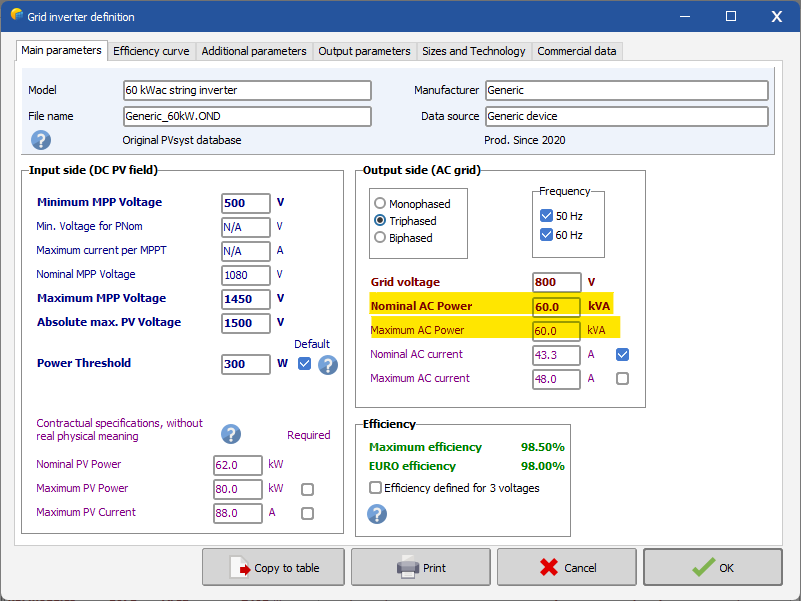
Each inverter has a nominal maximum power, which will determine the clipping level. This is defined in the OND, but of course you can also modify and save a new OND file.
-
There seems to be a "time zone" setting in the NREL TMY header, for example: 723740,"WINSLOW MUNICIPAL AP",AZ,-7.0,35.033,-110.717,1490 Did you try changing its value ? It may be zero currently and needs to be changed to -6.0, or the opposite way. Let us know if this works
-
Distribución de Potencia Salida del Sistema
Michele Oliosi replied to AlvaroRuiz's topic in Simulations
The difference is related to clipping here. In the first variant, you have some grid limitation or inverter clipping, which leads to power peaks being all concentrated to the 12175-12200 kW bin. -
Hi, There is nothing to do at the moment. Unfortunately, PVsyst cannot add a slope to the bifacial backside irradiance calculation. However, in the simulation, the front side irradiance is computed accurately with the 3D scene data, this doesn't change. Only the backside irradiance evaluation will suffer from not being a correct representation of the 3D scene. We will need to improve the model to correctly cover these situations, but it will take some time.
-
No the two questions are not really related I think. Here you are dealing with 3 things: The iso-shading diagram comes from the shading factor table. The table has discrete values. This is why the lines are "squared". Moreover the angles at which the table is evaluated is 2, 10, 20, ... which means that for 15° PVsyst will interpolate shadings from 10° to 20°, i.e.,the iso-shading will show non zero shading all the way to 20° even though the limit angle is 15°. If you want to avoid using interpolation, you can still switch to the "slow mode". If you use that, in the simulation, the shading will be accurately calculated for each simulation step. You are showing the electrical shadings table, which behaves more extremely. Even though you shade a small area, this means a lot of shading. In your case the shading at 10° is therefore close to 100% (electrical shadings).
-
In principle, you cannot input all of GlobHor DiffHor and GlPMeas when importing data. Which ones did you select in your MEF ? In order to use the GTI you need import only the GlPMeas. Where did you change the values manually ? I do not clearly see how to do that in PVsyst.
-
Diferencia Producciones entre Informe y Excel Bachsimulation.
Michele Oliosi replied to AlvaroRuiz's topic in Simulations
It may be due to the aging mismatch losses. Please check whether you have saved the mismatch values or not. If you can check the "Keeps calculated Mismatch values" box, please do so. Another way to investigate the problem is to display more variables in your output file. You can also define output files with monthly values and several variables, for the regular PVsyst simulation. Comparing them will lead you to the source of the issue. I notice that the units in the batch file output are incorrect, we need to address this.
-
Diferencia Producciones entre Informe y Excel Bachsimulation.
Michele Oliosi replied to AlvaroRuiz's topic in Simulations
Hello ! I'm leaving a translation in English - the forum communication language. ---- Good morning; After running several simulations of a certain project, I find that in several of the simulations, there is a difference in E_grid between the report and the Batch simulation. In the default simulation I have year 1, Pitch 6.5 meters, exactly the same parameters that I include in Excel BatchParams for the same conditions. I attach photos corresponding to the same simulation variable and without changing any data. I don't understand why this difference between report and Batch simulation, please if someone can help me I would appreciate it. Greetings to the entire community. -
Hi, here the main error is related to the bifacial modeling. Once the backtracking in the 3D scene and orientation agree, there should be no issue with backtracking. Please see the following help page https://www.pvsyst.com/help/bifacial-conditions.htm It should help you proceed with your simulation and see what is wrong.
-
3D SCENES- MULTIPLE ORIENTATIONS- BIFACIAL MODULES
Michele Oliosi replied to raulserr33's topic in Simulations
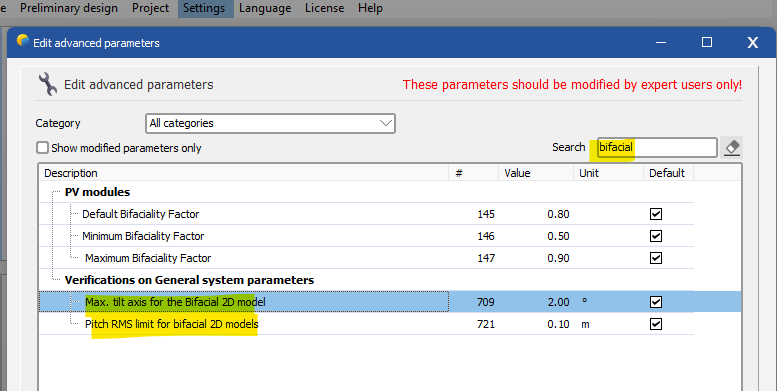
Home window > Settings > Edit advanced parameters.
-
You should actually change the following other parameter : "Max. tilt axis for the bifacial 2D model" This seems to be the reason for your problem, rather than the pitch
-
Horizontal and vertical PV modules as a system problem
Michele Oliosi replied to Filimena's topic in Shadings and tracking
Hi, At the moment, the bifacial model for the backside irradiance works only with a single orientation. You will have to split your system into two variants. -
Yes, PVsyst does at the moment recalculate the GTI from a GHI and DHI values. GHI and DHI may be generated from an input measured GTI. This is because as things stand, a MET file can be used with any orientation, i.e., it should be useable with an orientation other than that of the measured device. Moreover, the GTI itself does not have all the needed irradiance information, we need to decompose into diffuse components and direct component in order to make all calculations e.g., IAM or shadings. However, recomputed GTI and original GTI will in general differ by at most 1%.
-
How to calculate the irradiance on ground?
Michele Oliosi replied to squeezer's topic in Simulations
Hi, as far as PVsyst goes, this is not yet possible. The only variable that can be exported currently is the GlobGnd which gives you the average irradiance on ground in the system area (i.e. removing shading from the PV tables). But there is no spatial distribution. However we will indeed implement features that can help with agrivoltaic plants in the future. These features may come as soon as next year, although the schedule has not been set yet. -
V7.3.1 diffuse shade on trackers - issue with tracker selection
Michele Oliosi replied to Debbie's topic in Problems / Bugs
Actually the "automatic" selection is the historical way that was used in previous versions. We added the window for people to be able to have more control on the choice of trackers, while being able to use the "old" way. It became clear we had to propose other ways when we noticed the issue you point out. The related help page https://www.pvsyst.com/help/tracking_diffuse.htm -
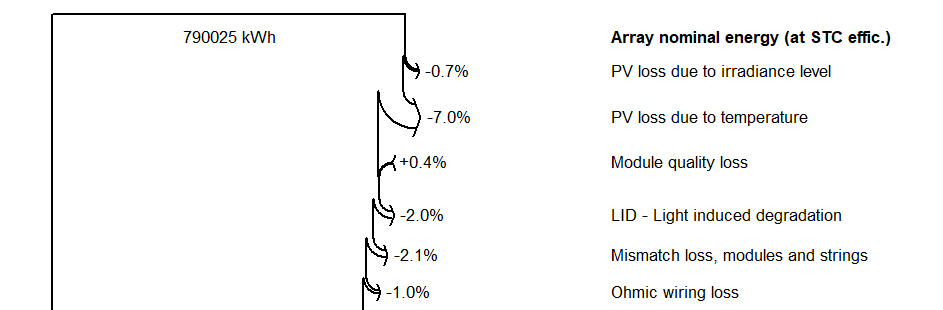
Dear Brij, It is incorrect to refer as the LID loss with respect to the nominal energy value. You have to consider the loss diagram flow: The LID is only accounted after the irradiance level, temperature, module quality losses (and other losses that may appear in your project). I.e. you need to change the value you use in B in your equation to account for these.
-
It is possible but it will only work if you use "arrays of tables", in particular if you have arrays that share the same pitch, orientation, and table sizes.
-
Correct partition layout for tables
Michele Oliosi replied to dennis.stu's topic in Shadings and tracking
Yes this looks ok ! -
@NIken if you can, in "Orientation" define two orientations each with their azimuth (e.g. -90° and +90°). Mixed orientation is the correct setup in the "System" window
-
Hi, did you also check the same operation hour by hour ? Since you have the 8760 file is a good cross-check in principle. Let us know how it looks.
-
Dear Ashley, There may be a problem with one or several of these files. If, for example, one of the files triggers an error (missing or nonphysical data), it could invalidate the TMY process. Can you send us the files at support@pvsyst.com? We can take a look at them.