

Hizir Apaydin
-
Posts
140 -
Joined
-
Last visited
Everything posted by Hizir Apaydin
-

An Error after updating to V. 7.2.6.22690
Hizir Apaydin replied to Kateryna Zakharova's topic in Problems / Bugs
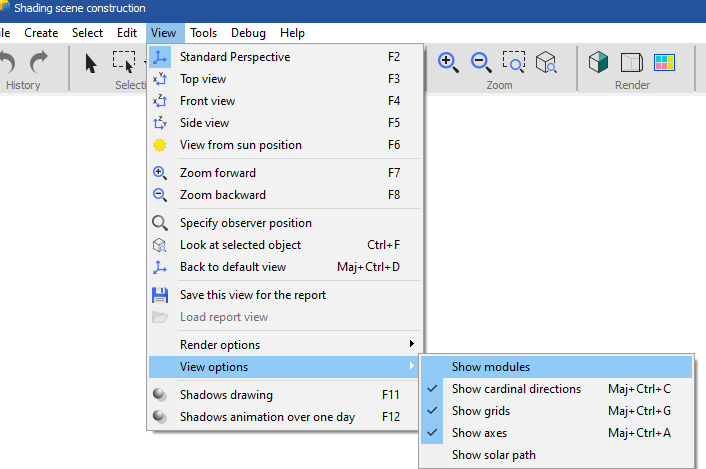
Dear Kateryna, There is indeed an issue with polygonal fields in PVsyst 7.2.6 and the fix will be available in the next version. In the meantime, here is a workaround to avoid the error: - Open a project variant that does not contain polygonal fields - Open “Near shadings” dialog - From the top menu, select “View”, “View options”, and uncheck “Show modules”. You will then be able to reopen shading scenes containing polygonal fields. Kind regards
-
Dear T.Geb, You can import into PVsyst an hourly load profile from a CSV file. The consumption index provided by Enedis contains 6 values per hour (consumption on 10-minutes periods). You will have to merge ten minutes values in hourly values and import the resulting CSV file in PVsyst from "Self consumption" / "Load values from CSV file" / "Choose CSV file" / "Browse" and select your hourly CSV file. The template provided by PVsyst (available under C:\Users\Username\PVsyst7.0_Data\UserHourlyParams) is an hourly CSV containing all the hours of the year in the first column, and the corresponding hourly consumption in the second column. You can have more details about this feature on this page https://www.pvsyst.com/help/load_file.htm Kind regards
-
Dear Yoline, Thank you for your interest in the economic evaluation tool of PVsyst. You can either define your costs in detail by setting the price of each module, inverter, structure under module, wires etc... or define them globally. For example, a photovoltaic system installer can give you a global price depending on the size of your installation, without giving you the detail of each cost. He can tell you that the global installation cost will be 200$/module, including components, wiring, transport, manpower etc. If your system contains 100 modules, your total installation cost will be 20 000$, without worring about the details. If you define all your prices individually (modules, inverters, wires, transport, installation), you don't have to set "Global installation cost per module", nor "Global installation cost per inverter", you can delete these costs from the list. Regarding the "Grid connection cost", this is the initial cost of connecting your photoltaic installation to the grid system in which you will inject your electricity. This includes the cost of the equipments needed to physically connect your system to the grid, and also several administrative costs (contract establishment, taxes etc...). This cost depends on the location of your installation (you will have to pay a higher grid connection cost if your photovoltaic installation is located in a place hard to reach, far from high voltage lines etc...) and also depends on the country (in some countries you can have high administrative fees). In some countries, you can also have to pay a yearly subscription or tax, in order to have the right to be connected to the grid. You can set this cost in "Annual connection tax" of "Tarrifs" tab. Anyway, the default list of costs provided by PVsyst is a fully customizable template. You don't have to set the costs which are not relevant for your project. You can add specific costs to your project, delete or modify existing costs. For more information about the economic evaluation, please have a look at this specific video tutorial: Kind regards
-
Dear customer, Please contact support@pvsyst.com and provide your customer ID and your license number in order to get assistance on this issue. Kind regards.
-
Hello, You can download PVsyst 7 from our website : https://www.pvsyst.com/download-PVsyst/ Best regards.
-
Financial Parameters - Depreciation Coefficient Help
Hizir Apaydin replied to rflack's topic in How-to
Dear Ryan, The declining balance option permits to accelerate the depreciation in the first years of the project according to a depreciation coefficient. This coefficient is entirely dependent on the taxation system of your country and the choosen taxation option, there are no typical or standard values. As examples, in France, for an amortization of 3-4 years, this coefficient is equal to 1.25, 1.75 for 5/6 years, and 2.25 for more than 6 years. In USA, this coefficient is defined in MACRS (Modified Accelerated Cost Recovery System), it depends on the system, company type ect... A common method is the "Double Declining Balance" method in which the coefficient has a value of 2. We don't have knowledge about the Australian tax system, but an accountant must know which method is applied for your system and what is the value for this coefficient. Here I found some information about depreciation methods in Australia : https://help.sap.com/viewer/2754875d2d2a403f95e58a41a9c7d6de/1811/en-US/2cbac733722d10148835ebe587377c69.html Best regards, -
Dear Nouslas, You can set up the electricity cost only when self-consumption is defined in order to calculate the "self-consumption economy". This is done in "Self-consumption saving" in "Tariff" tab from Economic Evaluation tool. When no self-consumption is defined, the cost of bought electricity is not taken into consideration for system profitability calculation, that's why the field for cost of electricity from grid would not be available. Best regards.
-
Dear Mr Sang Bui, This limitation will be increased in a future version of the software. Thank you for your interest in PVsyst.
-
Hello, The inflation rate is applied after first year : OPEX year 1 : 100 GBP OPEX year 2 : 100 + (100*10/100) = 110 GBP OPEX year 3 : 110 + (110*10/100) = 121 GBP OPEX year 4 : 121 + (121 *10/100) = 133 GBP OPEX year 5 : 133 + (133 *10/100) = 146 GBP Thus the average OPEX on project life is (100+110+121+133+146) / 5 = 122 GBP Regards
-
Dear Veselin, We thank you for your suggestion. Actually the cost of energy is visible in the economic evaluation tool and also in the report. The only difference with the strict LCOE definition is that it does not take into account the discount rate (net present value). But the strict LCOE value will be available in a future version of PVsyst. As you suggested, we are also planning to include economic optimizations in simulation according to some defined parameters. We thank you for your interest in PVsyst.
-
Dear Tuomas, Which version of PVsyst are you using ? Could you please export the project you are working on (Menu>File>Export Project) and send it to support@pvsyst.com in order that we can investigate about the issue ? Thank you.