All Activity
- Past hour
-
 Hi, The reason is that GlobGnd, DiffGnd and ReflLss are variables that refer to the m^2 of ground area. Whereas, BkVFLss refers to the m^2 of PV modules. If you were to mutiply by the respective surfaces (ground surface > module surface), the energy hierarchy would make sense.
 - Today
-
 This is what GlobGnd and GkVFLss described in PVsyst help GlobGnd Global incident on ground, below the system. ReflLss Ground reflection loss (albedo) BkVFLss Loss due to the view Factor for rear side So I think GlobGnd is source energy for other parameters such as ReflLss and DiffGnd etc. That means value of GlobGnd should be the largest during these parameters. But I processd some simulation and looked into details of results. I found that BkVFLss always larger than GlobGnd. Does anyone know why about this? GlobGnd DiffGnd ReflLss BkVFLss kWh/m² kWh/m² kWh/m² kWh/m² January 26.1 9.94 13.06 18.8 February 41.5 13.76 20.73 35.4 March 70.9 23.17 35.45 67.1 April 98.7 27.04 49.34 96 May 125 28.2 62.51 121.1 June 124 29.7 62 119 July 122.1 32.43 61.07 117.3 August 103.1 31.35 51.56 99.9 September 75.3 24.16 37.64 72.3 October 52.8 18.7 26.41 47.2 November 30.3 12.88 15.13 23.6 December 20 10.03 10 14.4 Year 889.8 261.35 444.88 832.2 albedo=0.5 GlobGnd=889.8 BkVFLss=832.2 GlobGnd DiffGnd ReflLss BkVFLss kWh/m² kWh/m² kWh/m² kWh/m² January 26.1 9.94 5.22 30 February 41.5 13.76 8.29 56.7 March 70.9 23.17 14.18 107.4 April 98.7 27.04 19.74 153.6 May 125 28.2 25 193.8 June 124 29.7 24.8 190.4 July 122.1 32.43 24.43 187.7 August 103.1 31.35 20.62 159.9 September 75.3 24.16 15.06 115.7 October 52.8 18.7 10.56 75.5 November 30.3 12.88 6.05 37.7 December 20 10.03 4 23 Year 889.8 261.35 177.95 1331.5 albedo=0.8 BkVFLss=1331.5
 -
Siping joined the community
- Yesterday
-
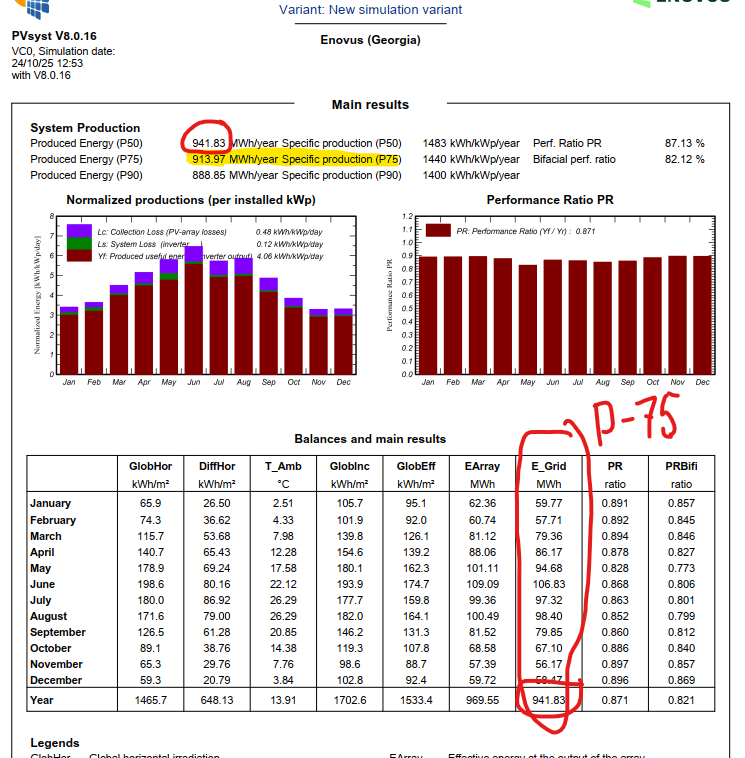
Hi everywone. Please tell me if it is possible on main rezults page to get yearly results -month by month with P75 figures. As default it shows P50

-
Hi, I have the following limitations from the grid: Import: capacity: 150 kVA, power factor: 0.95 lag to unity Export: capacity 15,000 kVA, power factor: 0.98 lead How should I introduce this in PVSyst? Should be 15 MVA and PF 0.98 lead or 15MVA and PF 0.95 lag? Thanks.
- Last week
-
 Brigitte joined the community
 -
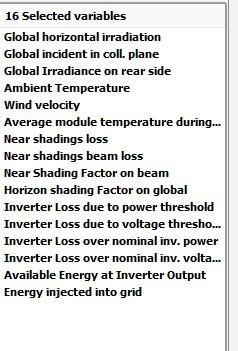
If bifacial is disabled, the variables will not be available, same for the horizon loss.
-

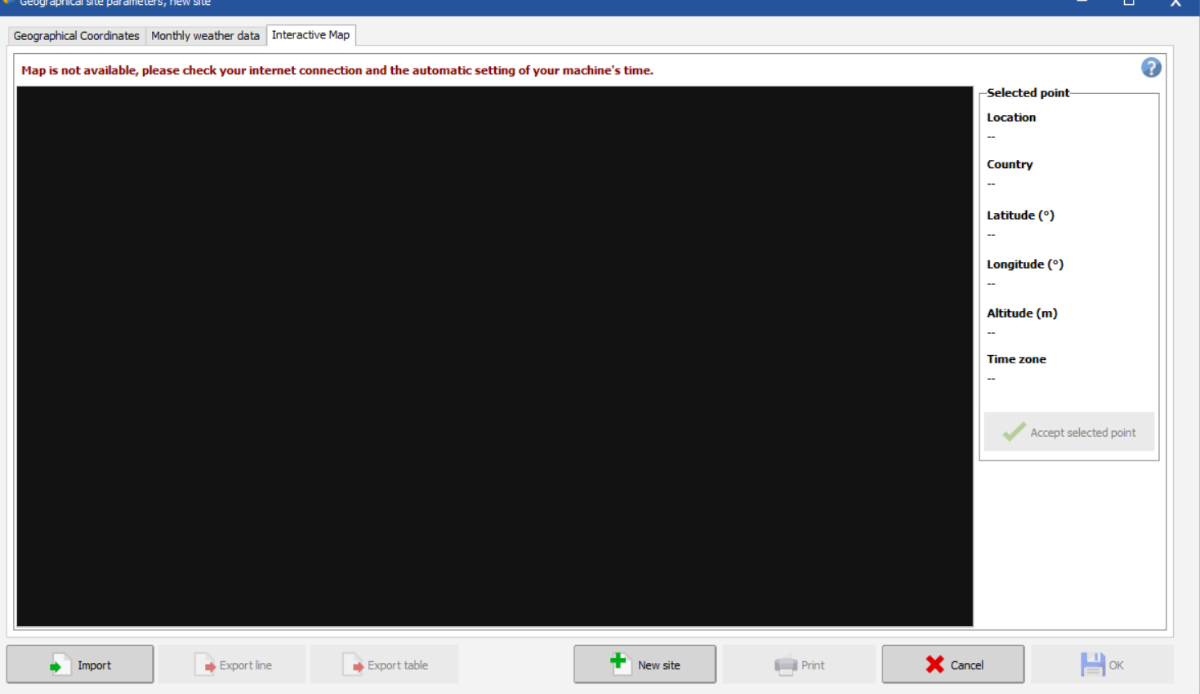
Problem in importing geographical site parameters
Laurent C replied to Vatsaa's topic in Problems / Bugs
Hello Vatsaa, Thanks for your post. It could be a network problem, also could you check that your machine time's is set automatically ? Finally you can send us some logs at support@pvsyst.com . Regards, Laurent -
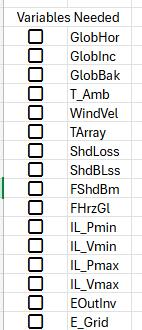
Hi We are working on a project that needs certain parameters in the 8760 (image attached) GlobBak (Global irradiance on the rear side) and FHrzGl (Horizon shading factor on global) does not show up in the 8760-csv file. Is it due to the bifacial model being disabled as projects are canopies, and if there are no far shading losses for the project? FHrzGl only does not come up for the sites where far shading losses are zero. I just wanted to confirm before responding to the client
-
Dear PVsyst Team, While importing new geographical site parameters, it is not able to locate the site in the geographical site parameters tab; the map becomes black and is not able to locate the site location. Is this a bug or anything we need to change in PVsyst to make it like before?
-
 Vatsaa joined the community
 -
We update the database using the requests of the manufacturers, and publish it with each new release of PVsyst. We can't of course follow all the new products of all manufacturers in the world. We don't want to include data without the acknowledgement of the manufacturer. Nevertheless you can easily create your own components by yourself. The easiest way is to choose a similar existing device in the database, modify its parameters according to the manufacturer's datasheets, and save it under a new name, therefore creating a new file in your database. You have a tutorial for that on youtube: https://www.youtube.com/c/PVsystTutos.
-
DiffGnd definition missing from documentation.
-
Hi, I'm trying to get the .pan file of the ZNShine, ZXM7-UHLDD144 595W module. Not having any luck with the manufacturer, if it's not too much trouble could someone please provide it if they have it. Thank you so much
-
 jmzdigital joined the community
 -
 WillShif joined the community
 -
Hello, Yes with different weather data sources the production will vary, since the irradiance data will vary. You find more information about the weather data providers and a comparison in the following PVsyst help page: https://www.pvsyst.com/help/meteo-database/import-meteo-data/data-source-comparison.html
-
Citing the Hay Transposition Model in the PVsyst References
Michele Oliosi replied to kjs55's topic in Suggestions
Funny, I just added this in the help of our 8.1 candidate a few days ago. Hence sure, will be present in 8.1 🙂 Indeed, that is the correct citation. -
Hi, I conducted a study on hourly values for a solar power plant (SPP). I compared two different meteorological data sources. Meteonorm shows higher production in the morning than PVGIS, while PVGIS shows higher production in the afternoon than Meteonorm. Why are the production values different? Meteonorm (kW) PVGIS(kW)
-
 Emre Sagir joined the community
 -
Could you please add the formal citation for the Hay transposition model to the PVsyst Help References? It would be very helpful to have the primary source explicitly listed alongside the other physical models at these locations: V7: https://www.pvsyst.com/help-pvsyst7/index.html?references.htm V8: https://www.pvsyst.com/help/references.html My assumption is that it is the following citation (IEEE format): J. E. Hay and J. A. Davies, "Calculations of the solar radiation incident on an inclined surface," in Proc. 1st Canadian Solar Radiation Data Workshop, 1980, pp. 59–72.
-
You can download time-series data (20+ years) from https://nsrdb.nrel.gov/data-viewer. From there you can calculate it manually from GHI or import each year into PVsyst. You can also get ~18 years of data at PVGIS free https://re.jrc.ec.europa.eu/pvg_tools/en/#MR.
-
This tool is meant to compare .MET files, you first need to create several .MET files using different data sources
- Earlier
-
Hi, I tried with the second link to stimate a location but I coul not get an output. What should I do?
-

Bifacial Performance Ratio Formula in PVsyst V7 Help Menu
Auriane Canesse replied to kjs55's topic in Suggestions
Thank you for the report. Note that this bug was corrected in PVsyst 7.2.17 https://www.pvsyst.com/help/release-notes/index.html#exec-1--version-7217 -

No view for the report only black screen
Hizir Apaydin replied to Petr Pasek's topic in Problems / Bugs
Dear Petr, The problem seems to be related to a driver issue. You can try to update this driver by following the procedure documented in our FAQ: https://forum.pvsyst.com/topic/1253-updating-your-graphics-card-driver-pvsyst-660-and-above Alternatively, you can follow the procedure linked below: https://nvidia.custhelp.com/app/answers/detail/a_id/5035/~/run-with-graphics-processor-missing-from-context-menu%3A-change-in-process-of In order to try to run PVsyst with the second graphic card driver of your PC (if you have one). This selection is available in Windows settings (in Graphics settings) after you have chosen PVsyst program file: https://desk.zoho.eu/galleryDocuments/edbsn7903bf68f74bdf02e267dfb94ecb7a844a3b3dfe543b433eda69af27a6de02cfce10a448941bc47fa2fd77e1e764447e75de7024769cf0298f804ff62b2e141f?inline=true If you use a virtual machine (VMWare, VirtualBox, ...), remember to activate hardware acceleration and be up to date. If you are using the AMD “Adrenalin Edition”, please try using another driver using this procedure: https://www.youtube.com/watch?v=O94izh6mwOk We remain at your disposal for any other assistance that may be required. -
 Shailja Sadhu joined the community
 -
 nurul joined the community
 -
Please help with the problem of generating a preview for a report. I don't know what else to try. Thx
-
PVsyst V7.2.16: PVsyst V7’s Help Menu (https://www.pvsyst.com/help-pvsyst7/index.html?performance_ratio.htm) defines the bifacial PR as PRbifi = PR / (1 + (GlobBak + BackShd)/GlobInc), i.e., adding BackShd to GlobBak. In my V7.2.16 run, the reported PRbifi aligns only when BackShd is effectively subtracted, which points to a doc/implementation mismatch in the V7 build.
-

Albedo shading component calculation
Linda Thoren replied to ClaireWest's topic in Shadings and tracking
The albedo shading loss will be the same. But with all the parameters set for a bifacial system the variable "ground reflection on front side" is added for the inter-row ground reflection, as described in the help page. For a monofacial system, the irradiance that falls between the rows is not calculated and the contribution of the ground reflection on front side is in general negligible for systems with a low tilt angle. To evaluate this gain, at the moment you need to set the bifacial parameters as described above. -

Albedo shading component calculation
ClaireWest replied to ClaireWest's topic in Shadings and tracking
Are you saying that the (front-side) near shading loss would be lower if i modelled a bifacial system because these systems are more precisely modelled or defined, even though the near shading losses happen before any bifacial modelling in the loss diagram (and should be independent of whether the system is mono or bifacial)? -
Hi, The bifacial model presently available in PVsyst is based on a simplified 2-dimensional representation, with similar assumptions as the "unlimited sheds" or “unlimited Trackers” PVsyst simplified calculation. This approximate calculation may be extended to a 3D scene, provided that this 3D scene is sufficiently well represented by the "Unlimited sheds or trackers". Thus, simply use the option "Use unlimited sheds 2D-model" in your second print screen. You find a tutorial about the bifacial model conditions for the 3D scene below: